How to Become an Information Technology Manager
10/08/2026
If you're interested in technology and leadership, you may be wondering how to become an information technology manager. According to the U.S. Bureau of Labor Statistics, these professionals, often called IT managers, plan, coordinate, and direct computer-related activities in an organization, helping determine its IT goals and overseeing the systems that meet them.1 Becoming one typically involves a combination of education, hands-on technical experience, and the steady development of leadership skills over time.2
In this article, we'll walk through the general path into IT management, what these professionals do day to day, the skills the role draws on, and how a degree may fit into the picture.
Step 1: Earn Relevant Education
A common starting point for IT management is building a technical foundation through a degree. According to the U.S. Bureau of Labor Statistics, these managers typically need a bachelor's degree in computer and information technology or a related field, such as engineering technologies, with coursework that often includes computer programming, software development, and mathematics. Management information systems (MIS) programs tend to blend that technical coursework with business classes. Some organizations require or prefer that candidates hold a graduate degree in computer science, information technology, or business administration.2
Rasmussen University part of American Public University System (“Rasmussen University”) does not offer any programs in Engineering and does not offer any graduate level programs in Computer Science or Information Technology.
Rasmussen University’s online Bachelor of Science in Information Technology Management is one educational pathway. It's a degree-completion program for students who have already earned an associate degree or specified college credit, designed to help build technical and analytical skills alongside leadership, project management, and team management capabilities.3
Step 2: Build Technical Skills
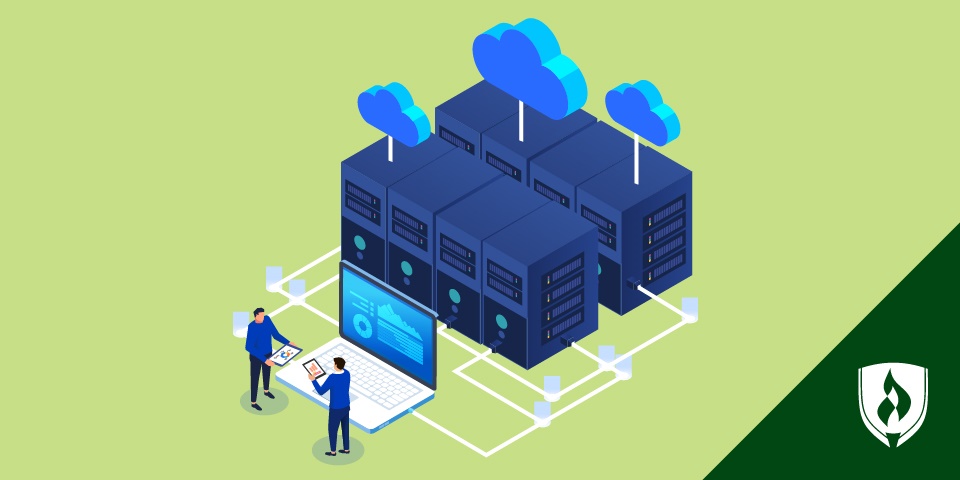
IT management rests on a solid grasp of the technology it oversees. IBM® notes that a typical IT environment brings together many moving parts, including computers, servers, applications, and mobile technologies, which may run on site, in the cloud, or across a combination of the two. Building familiarity with the core areas of that environment is foundational, including:⁴
- Networking
- Systems administration
- Cybersecurity fundamentals
- Cloud computing
- Database management
- IT infrastructure
- Troubleshooting
Coursework can help develop these competencies. Rasmussen University's program covers skill areas such as setting up and maintaining networks, troubleshooting hardware and software, systems support and administration for web and database applications, and topics including cloud computing, network security, and data security.3
Step 3: Gain Hands-On Experience
Education builds the foundation, but the Bureau of Labor Statistics notes that computer and information systems managers typically also need work experience in a related IT job, and how much experience is expected can vary by position. A help desk manager, for example, may need several years of experience as a computer support specialist, while an IT security manager may need to have worked as an information security analyst. Senior-level roles, such as chief technology officer or IT director, usually call for many years of experience in the field.2 The specific path into management still varies from person to person and employer to employer.
Step 4: Develop Leadership and Business Skills
Technical knowledge alone doesn't define an IT manager. The Bureau of Labor Statistics notes that these managers often work closely with top executives and other managers to assess an organization's computer and information system needs.1 That calls for the kind of qualities the Bureau highlights as important for the role: the ability to communicate clearly, make decisions about how to allocate resources, and lead a team effectively.2
Skills that tend to matter in this area include:2
- Leadership
- Communication
- Decision-making
- Analytical thinking
- Problem-solving
Step 5: Consider Industry Certifications
Industry certifications are optional credentials that some technology professionals pursue to demonstrate knowledge in specific areas, and the Bureau of Labor Statistics notes certification can be particularly relevant for managers who oversee areas like IT security.2 Common examples relevant to IT management include CAPM®, ITIL®, and Six Sigma® White Belt.
As a program feature, Rasmussen University's IT Management program is designed to help prepare students to pursue these three certifications, and reimburses out-of-pocket application fees for the first attempt of up to three designated exams.3
What Does an Information Technology Manager Do?
Day to day, an IT manager's work tends to center on a handful of broad responsibilities. According to the U.S. Bureau of Labor Statistics, these managers plan, coordinate, and direct an organization's computer-related activities, working to determine its IT goals and implement the systems that meet them. Common parts of the job may include:1
- Assessing technology needs: Analyzing an organization's IT needs and recommending upgrades
- Overseeing systems and security: Planning and directing the installation and maintenance of hardware and software, and establishing processes to detect and prevent IT security threats
- Managing budgets and projects: Assessing the costs and benefits of new projects and justifying funding for them
- Leading technical teams: Determining personnel needs and directing the work of other IT staff, such as systems analysts, developers, and support specialists
- Working with vendors: Negotiating with and monitoring vendors to ensure they meet the organization's IT needs
Job responsibilities can vary quite a bit by organization. Some IT managers oversee an entire department, while others focus on one area, such as infrastructure, support services, or cybersecurity.1
Skills Information Technology Managers Need
The role draws on a blend of skill sets:
Technical Skills
A working understanding of networks, systems, security, and infrastructure, along with the technologies an organization relies on day to day.⁴
Analytical and Problem-Solving Skills
Evaluating information to develop strategic plans, determining how to allocate resources, and troubleshooting issues as they arise.2
Leadership Skills
Directing and motivating IT teams or departments so that work gets done efficiently and effectively.2
Communication Skills
Explaining technical work clearly to top executives and giving clear direction to IT staff.2
Typical Career Paths in IT Management
An IT management background may be relevant to a range of technology roles. Career paths associated with Rasmussen University's program include information technology manager, network analyst, and network administrator.3
Information technology manager. According to the U.S. Bureau of Labor Statistics, these professionals, also called computer and information systems managers, plan, coordinate, and direct computer-related activities in an organization, helping determine its IT goals and overseeing the systems that meet them. Depending on the organization, this role may carry other titles, such as chief information officer, chief technology officer, or management information systems director.1
Network analyst. Roles in this area focus on networks and their security. CompTIA describes the network security analyst as someone who builds and puts in place measures to safeguard an organization's data, networks, and systems, with work that can include watching network traffic for unusual activity, looking for new ways to strengthen protection, and helping prepare network recovery plans.⁵
Network administrator. According to the U.S. Bureau of Labor Statistics, these professionals set up and maintain the networks and systems an organization depends on. Network administrators in particular tend to concentrate on the equipment that links an organization's computers together, such as routers, switches, and cabling, keeping local and wide area networks running.⁶
These roles may require additional education, certifications, or experience depending on the employer and specific position.3
Explore Rasmussen University's IT Management Bachelor's Degree
Rasmussen University's online Bachelor of Science in Information Technology Management offers flexible online courses designed to help students build technical and leadership skills at their own pace. The program is transfer-credit friendly and may be completed in as few as 18 months, depending on factors such as course load and scheduling.3
Degree: Bachelor of Science in Information Technology Management3
Length: May be completed in as few as 18 months for full-time students, depending on factors such as course load and scheduling3
Courses: 23 courses. Students who have fewer than 90 transferable lower-level quarter credits will be required to take additional lower-level coursework. The additional coursework will be determined by Rasmussen University based upon a predetermined elective pool appropriate for the program of enrollment. The total Bachelor’s degree credits is 180.3
Certification Preparation: Designed to help prepare students to pursue CAPM®, ITIL®, and Six Sigma® White Belt certifications, with first-attempt exam application fees reimbursed for up to three designated exams3
If you're exploring how to become an information technology manager, learn more about Rasmussen University's program to see how it may help you build the skills relevant to pursuing this path.3
Earning a degree does not guarantee employment or specific job outcomes. Employment conditions in your area may vary.
IBM® is a registered trademark of International Business Machines Corporation, New Orchard Road, Armonk, New York 10504.
CompTIA® is a registered trademark of CompTIA, Inc., 3500 Lacey Road, Suite 100, Downers Grove, Illinois 60515.
Six Sigma® is a registered trademark of Global Six Sigma USA, LP, 7301 RR 620 N, Ste 0362, Austin, Texas 78726.
Certified Associate in Project Management® is a registered trademark of Project Management Institute, Inc., 18 Campus Boulevard, Suite 150, Newtown Square, Pennsylvania 19073-3230.
CAPM® is a registered trademark of Project Management Institute, Inc., 18 Campus Boulevard, Suite 150, Newtown Square, Pennsylvania 19073-3230.
ITIL® is a registered trademark of Axelos Limited, 192 Sloane Street, London SW1X 9QX, United Kingdom.
1Bureau of Labor Statistics, U.S. Department of Labor, Occupational Outlook Handbook, Computer and Information Systems Managers, at https://www.bls.gov/ooh/management/computer-and-information-systems-managers.htm#tab-2 (accessed August 7, 2026). Employment conditions in your area may vary.
2Bureau of Labor Statistics, U.S. Department of Labor, Occupational Outlook Handbook, Computer and Information Systems Managers, at https://www.bls.gov/ooh/management/computer-and-information-systems-managers.htm#tab-4 (accessed August 7, 2026). Employment conditions in your area may vary.
3Rasmussen University, Information Technology Management Bachelor's Degree, at https://www.rasmussen.edu/degrees/technology/it-management/ (accessed May 29, 2026).
4IBM®, What is IT management?, at https://www.ibm.com/think/topics/it-management (accessed May 29, 2026).
5CompTIA®, Your Next Move: Network Security Analyst, at https://www.comptia.org/en-us/blog/your-next-move-network-security-analyst/ (accessed May 29, 2026).
6Bureau of Labor Statistics, U.S. Department of Labor, Occupational Outlook Handbook, Network and Computer Systems Administrators, at https://www.bls.gov/ooh/computer-and-information-technology/network-and-computer-systems-administrators.htm#tab-2 (accessed May 29, 2026). Employment conditions in your area may vary.