For most of us, any understanding we have of bomb technicians comes from movies and TV shows. Should you cut the red wire or the green wire!?
It’s so pervasive that the scenario of diffusing a bomb can seem entirely fictional. But bomb squads and bomb technicians do exist in our real lives. You can make working on the bomb squad part of your career.
But to do that, you need a whole lot more than steely nerves and knowing the difference between red and green. (Which, it turns out, has nothing to do with actual bomb disposal, alas).
“One thing about bomb teams that the public does not realize is the amount of personal time these team members devote to training and practicing,” says Eileen Carlin, instructor in the Law Enforcement program at Rasmussen University.
"These team members work all day as officers and then go to training after work, and they also meet on weekends. They are devoted to their team,” Carlin explains. “That is something that is difficult for most people to understand.”
If you’re curious about the job that inspires this level of devotion, read on and learn about the actual role of the bomb squad.
What happens at the start of a bomb threat?
Let’s take this from a scenario where the 911 dispatcher gets a call about a bomb threat.
“If someone calls to report a bomb threat, the first thing that would happen is that the police would have the building evacuated,” Carlin says. The dispatcher would also send both the fire department and the bomb K-9 unit.
At this stage, the teams would work together essentially to verify if the threat is actually real—if an explosive device might be present, according to Carlin. The K-9 dogs (with their incredible senses) and their handlers have training in detecting many different compounds involved in explosives.
"If the K-9 alerts on an area, the bomb technicians would go in to investigate,” Carlin says.
How do bomb technicians diffuse the bomb?
The process of making a bomb not blow up is usually called “disposal.” And because an explosive device can be anything from old WWII munitions to an improvised explosive device (IED) made from someone’s imagination (to a sophisticated, military-grade package—bomb disposal technicians want to know everything there is to know about anything that could explode.
Which means they have to know how to make bombs themselves.
Step 1: Recon with the robot
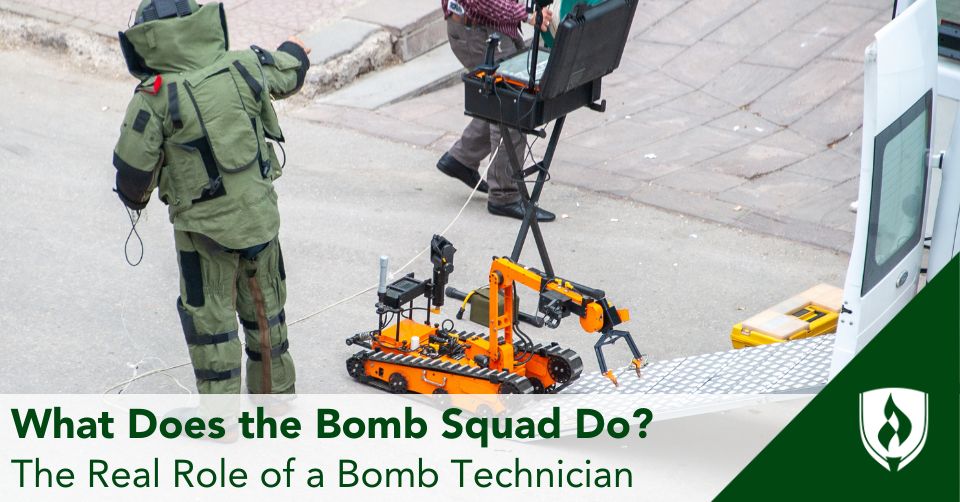
Whenever possible, bomb technicians utilize robots to approach any device. For reconnaissance, they will maneuver the robot (equipped with video cameras, sensors and usually, X-Ray capabilities) near the bomb to best determine how they can dispose of it, according to former Air Force officer, Brian Castner.2
These robots are not cheap, and the U.S. Department of Homeland Security’s science and technology arm is constantly adding new innovations to their technology to make bomb disposal safer and more effective.3
Step 2: Determine the best option for disposal
If the robot doesn’t blow up (or even if it does), the bomb squad will use the footage and the X-Rays it retrieved to decide what to do next.
They will look for the basic components of any explosive—a power supply, a switch, a container, and conductors or wires, according to John Stewart, unit chief of the Hazardous Devices School.4
The team will identify as much as they can about the nature of the bomb, whether it’s military ordinance or a homemade IED. And if those—what kind of explosion it will create, and how.
Step 3: Stop it from blowing up
The safest option for disposal will almost always involve the robot, according to Castner. But bomb threats occur in such variety that doing the disposal remotely isn’t always possible.
When it comes to improvised explosive devices, the FBI categorizes them into 3 primary means of detonation.4
- Victim-initiated (meaning someone has to do something to set it off, like be nearby, touch something or step on something)
- Time-initiated (the thing has a timer)
- Radio or signal-initiated (made to explode based on receiving a remote signal)
This is where the movie misconceptions really shine—bomb disposal techs and their robots almost never cut wires!
They do, however, make their own bombs.
One of the ways bomb disposal technicians disarm a bomb is by creating their own targeted and controlled explosion, according to Castner. This option is called an “energetic tool” …in what may well be the understatement of the industry.
If the bomb squad determines they can use an energetic tool to disable the device, they will attempt to place it in the gripper of a robot, maneuver the robot up to the bomb, and have it place the device while any humans are all a safe distance away.
Bomb techs will use many different tech options during this process, as well, like a disrupter to get in the way of any potential trigger signals.
They will also assume the presence of other explosive devices nearby and meticulously search the area.
An explosion will involve three primary areas of potential damage to people and things nearby, according to Stewart.4 These include...
- Fragmentation damage (the bits that get blown apart, everything from broken windows to shrapnel from the device)
- Thermal damage (the heat wave generated by the explosion)
- Blast wave (the invisible wave of pressure that can damage ears, internal organs, glass, etc...)
If the robot can’t handle the situation, a bomb technician will get into a bomb suit to approach the device, perform diagnostics and place a disruption tool of some kind.4
The type of disruption tool might involve explosives, water, a precision shot, all three, or more. The analytical and extensive knowledge bomb technicians train into gets put to use here.
The number one priority in any bomb disposal is the safety, not only of civilians, but of the bomb techs themselves. They are highly-trained to take the safest possible option in any scenario they encounter, and if they do have to risk their lives at any point—it's only because there was no safer alternative.
4 Main types of bomb disposal technicians
In the same way that there are many different tiers of law enforcement (think local police, state troopers, federal agents), there are also different tiers of bomb squad. According to FEMA, those are:1
Type I Bomb Squad
Type 1 indicates a full-time bomb squad, capable of handling a complex incident like multiple life-threatening devices, remote firing systems or sophisticated materials. These teams are required to have at least 10 bomb technicians, 2 supervisors and training in chemical, biological, radiological, and nuclear defense.
Type II Bomb Squad
Type 2 can be either a full-time or part-time bomb squad, capable of handling a moderate incident. Moderate incidents would be something life-threatening or time-sensitive, involving fairly-sophisticated, improvised devices. These teams must have at least 6 bomb technicians and 2 supervisors and have resources to handle a medium vehicle-borne IED and anything smaller. They should also be able to navigate chemical, biological, radiological, and nuclear materials (except vapors, that’s for Level 1).
Type III Bomb Squad
Type 3 indicates a full-time or part-time bomb squad, capable of handling a small incident. These teams need at least 2 bomb technicians who can dispose of basic improvised explosive devices. They should also be able to work in chemical, biological, radiological, and nuclear environments that don’t include liquids or vapors.
Explosive Ordinance Control (EOD) Officers
This category of bomb squad is the military designation. Bomb technicians in the military are typically working with a very different scope of explosives and might work in war zones where explosives occur constantly.2
Where do professionals in the bomb squad work?
Bomb squads work under state police, a county sheriff’s office or large cities, according to Carlin.
“For example, large cities such as Minneapolis, Philadelphia, Los Angeles and New York have their own bomb squads,” Carlin says. “While smaller departments who do not have their own bomb squad would be able to call the county sheriff or state police if they need one.”
In 2018, the U.S. Department of Homeland Security reported connecting 466 bomb squads of various types and sizes under their Response and Defeat Operations Support (REDOPS) program.3
But generally, Carlin says official institutions do not advertise information about their bomb units.
“No city makes public the number of bomb experts they have for a number of reasons. First, the number may change as team members retire or quit. Second, criminals do not need to know how many team members are on a bomb squad, and third, bomb squad members often serve other functions in the department in addition to being a team member,” Carlin explains.
How to become a bomb squad technician
It won’t come as any surprise that this job isn’t a good fit for many people.
People who enjoy taking risks (for example) would not fit well in the methodical, meticulous and highly-calculated work bomb technicians do. This role favors an analytical mind. But you do need to be aware that you will be working in situations that could endanger your life.
You must also gain a few different steps of education, according to Carlin. These include...
- Become a police officer (attend a law enforcement program, get hired, then pass the police academy) and join that department’s bomb squad.
- Attend and graduate from the FBI Hazardous Devices School (an intensive post-academy training school to learn about explosives, electronics, tools, and techniques for rendering devices safe).
- Then, complete advanced training and re-certify every three years to maintain your status.
After education, bomb disposal technicians also need to be ready to give well beyond the typical 9-5 work week. Their work is based on emergencies, and emergencies don’t wait for reasonable hours on a Monday.
How frequently do bomb threats occur?
Bomb squads have areas they handle, based on their type of team.
“The courthouse where I worked had a bomb threat almost every Thursday,” Carlin says. “Each time, we had to evacuate and call in the K-9 and fire department until the building could be cleared.”
“As an officer, my duties were to question whoever answered the phone when the threat came in, to document the evacuation, and to maintain crowd control outside until the building could be cleared,” she explains.
“Most of the time, the threat is not real,” Carlin says. “At the courthouse, our detective eventually identified who was calling in the threats.”
According to Carlin, bomb disposal technicians are often occupying other roles, and only step into their bomb-related duties when a threat appears. “Bomb squad personnel are all sworn police or sheriff’s officers,” she explains. “They perform their regular police duties until being called out for a threat.”
The bomb squad is a life-changing commitment
As you can see, working on the bomb squad involves dedication that goes beyond what most people put into their profession.
“These professionals do not complain about the lack of work/life balance,” Carlin says. “This team is their life. They have a passion for what they are doing, and there can be no mistakes—ever—because any mistake would result in a loss of life.”
“If you aren’t willing to give it your all, then you should not consider the bomb squad,” Carlin says. “It is not a half-time hobby… it is a full time, life changing commitment and that team becomes your family.”
If you might be the right kind of person for this role, the process begins with becoming a sworn-in police officer. Check out How to Become a Police Officer: Your Step-by-Step Guide.
1U.S. Department of Homeland Security, Federal Emergency Management Agency (FEMA) https://www.fema.gov/doc/nims/bomb-squad-table.doc
2Ferrera, Matthew, Former Air Force bomb diffuser says what the job is really like and that cutting the red wire is a Hollywood trope, (Oct 29, 2025) Business Insider. https://www.businessinsider.com/former-air-force-bomb-officer-job-hollywood-myths-life-after-2025-10
3Snapshot: Bomb Disarming with High- and Low-Tech Solutions, FEMA, July 24, 2018 https://www.dhs.gov/science-and-technology/news/2018/07/24/snapshot-bomb-disarming-high-and-low-tech-solutions
4FBI Agent Explains How Bombs Are Disposed Of | Tradecraft , WIRED Magazine, Oct 23, 2019 https://www.youtube.com/watch?v=nW_P2ngKPws
5The Law Enforcement Associate’s degree program is not aligned to the standards of any professional licensing body other than the MN POST and is not intended to satisfy professional licensure requirements of any professional licensing agency in any other state.
6The Criminal Justice Leadership and Management Bachelor’s degree and Criminal Justice Associate’s degree programs have not been approved by any state professional licensing body, and the programs do not lead to any state-issued professional license. For further information on professional licensing requirements, please contact the appropriate board or agency in your state of residence. Additional education, training, experience, and/or other eligibility criteria may apply.
7In Minnesota, the Criminal Justice Associate’s degree program does not meet the standards established by the Minnesota Peace Officer Standards and Training Board for persons who seek employment as a peace officer.