What Can You Do With a Healthcare Degree?
10/08/2026
The material contained in this blog is for informational purposes only and is not to be interpreted as advice or guidance.
If you're drawn to working in healthcare but aren't sure you want a role in direct clinical care, you may be wondering what kinds of healthcare support and administrative roles a healthcare degree may be relevant to. The short answer: it can point toward a range of administrative and support roles across clinics, hospitals, and pharmacies, from front-office and medical secretary positions to office coordination and pharmacy support. Healthcare runs on more than doctors and nurses, and a healthcare degree may help prepare students for support and administrative roles in healthcare.1
In this article, we'll look at what a healthcare degree generally involves, the kinds of roles it may be relevant to, and the skills that tend to matter in this work.1
What Is a Healthcare Degree?
"Healthcare degree" is a broad term that can cover a range of programs. Many focus less on direct clinical practice and more on the administrative, operational, and patient-support side of healthcare, the work that keeps facilities organized and patients moving smoothly through the system. Rather than training someone to practice as a nurse or physician, this kind of education tends to build foundational healthcare knowledge alongside communication and business skills that apply across many settings.1
That focus makes a healthcare degree relevant to a variety of support and administrative roles, from front-office positions to office coordination and pharmacy support. The specific direction often depends on where someone chooses to concentrate their studies.1
Roles a Healthcare Degree May Relate To
Because healthcare organizations rely on a wide range of support and administrative staff, a healthcare degree may be relevant to several roles. Here's a closer look at a couple of them.
Medical Secretary, Administrative Assistant, or Receptionist
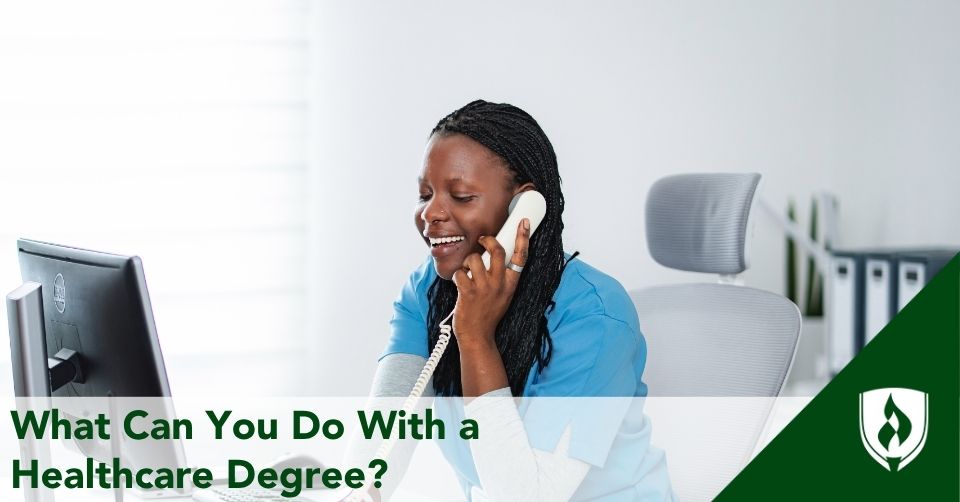
Front-office roles are often the first point of contact for patients. Receptionists typically handle administrative tasks such as answering phones, scheduling and confirming appointments, greeting and checking in visitors, and entering information into an organization's system. In a healthcare setting, this may also include collecting patients' personal information, directing them to the waiting room, and handling billing and insurance payments.2
Pharmacy Technician (Retail and Clinical Settings)
Pharmacy support roles can be found in both retail and clinical settings. Pharmacy technicians help pharmacists dispense medications, manage inventory, and provide customer service, working under a pharmacist's supervision. Their work may include gathering the information needed to fill a prescription, measuring and labeling medications, organizing inventory, processing payments and insurance claims, and entering patient information into a computer system. The setting shapes the work: technicians in hospitals and other medical facilities may prepare a wider variety of medications, such as intravenous ones, and may make rounds dispensing medications to patients, while those in retail pharmacies spend more of their time on customer-facing tasks.3
Skills That Support Healthcare Roles
Although these roles differ in their day-to-day work, they draw on a lot of the same underlying skills. A few themes stand out:
- Clear speaking and writing runs through all of these roles, whether conveying information to staff and patients as an administrator, corresponding with the public as a receptionist, or taking prescription orders accurately as a pharmacy technician.4,5
- Customer and patient service. Front-office and pharmacy roles involve a lot of direct interaction, so being courteous, helpful, and professional matters. Pharmacy technicians in particular spend much of their time interacting with customers.4,5
- Interpersonal skills. Being comfortable working with people across different situations is important, including showing empathy and understanding toward patients who may be unwell.4,5
- Attention to detail. Accuracy carries real weight in healthcare. Administrators may organize scheduling and billing for large facilities, while pharmacy technicians must be careful in filling prescriptions, since mistakes can have serious consequences.5
- Organizational skills. These roles involve juggling a range of responsibilities at once, from managing records and schedules to balancing customer service with delegated tasks.4,5
- Integrity and confidentiality. Handling sensitive patient information, especially in medical settings, calls for trustworthiness and protecting privacy.4
- Technical and computer skills. Comfort with computers and healthcare systems is increasingly central, from electronic health record systems for administrators to the record and dispensing systems used in front-office and pharmacy settings.4
- Analytical and leadership skills. On the management side, reviewing healthcare metrics to improve efficiency, and hiring, training, and directing staff, are part of the work.5
- Math skills. For pharmacy technicians, understanding the math used in pharmacies, such as calculating dosages, is part of the job.5
A healthcare program is one structured way to build these abilities, often blending healthcare-specific knowledge with communication and business fundamentals.
Is a Healthcare Degree Right for You?
If you're interested in healthcare and enjoy organizing, communicating, and helping people, but aren't necessarily drawn to hands-on clinical care, the administrative and support side of the field may be worth exploring. It's an area with a range of entry points, and the right one often depends on your interests and the level of study that fits your situation.
Exploring a Healthcare Program
For those who decide this path fits their goals, a focused program may be a useful next step. Rasmussen University part of American Public University System (“Rasmussen”) offers an online Healthcare Associate’s degree with specializations in Medical Administrative Assistant and Pharmacy Technician.
In Florida and Minnesota Rasmussen offers a Healthcare Associate’s degree program with a specialization in Medical Assisting. Current students who are enrolled in the Medical Assisting Diploma program may concurrently enroll in the residential version of the Healthcare Associate’s Degree Medical Assisting specialization program. Students must successfully complete all diploma program coursework to earn an Associate’s Degree with Medical Assisting Specialization. Students who have graduated from a Medical Assisting Diploma program from an accredited institution, including Rasmussen, are eligible to enroll in the fully online version of this program.
In Illinois Rasmussen offers a Health Sciences Associate’s degree program with specializations in Healthcare and Medical Assisting. Current students who are enrolled in the Medical Assisting Diploma program may concurrently enroll in the residential version of the Health Sciences Associate's Degree-Medical Assisting specialization program. Students must successfully complete all diploma program coursework to earn an Associate's Degree with Medical Assisting Specialization.
Students who have graduated from a Medical Assisting Diploma program from an accredited institution, including Rasmussen, are eligible to enroll in the fully online version of the Healthcare Associate of Applied Science-Medical Assisting specialization program through Rasmussen.1
Earning a degree does not guarantee employment or specific job outcomes. Employment conditions in your area may vary. Role titles, duties, and requirements vary by state and employer.
1Rasmussen University, Healthcare Associate's Degree, at https://www.rasmussen.edu/degrees/health-sciences/health-care/associates/ (accessed July 6, 2026).
2Bureau of Labor Statistics, U.S. Department of Labor, Occupational Outlook Handbook, Receptionists, at https://www.bls.gov/ooh/office-and-administrative-support/receptionists.htm#tab-2 (accessed July 6, 2026). Employment conditions in your area may vary.
3Bureau of Labor Statistics, U.S. Department of Labor, Occupational Outlook Handbook, Pharmacy Technicians, at https://www.bls.gov/ooh/healthcare/pharmacy-technicians.htm#tab-2 (accessed July 6, 2026). Employment conditions in your area may vary.
4Bureau of Labor Statistics, U.S. Department of Labor, Occupational Outlook Handbook, Receptionists, at https://www.bls.gov/ooh/office-and-administrative-support/receptionists.htm#tab-4 (accessed July 6, 2026). Employment conditions in your area may vary.
5Bureau of Labor Statistics, U.S. Department of Labor, Occupational Outlook Handbook, Pharmacy Technicians, at https://www.bls.gov/ooh/healthcare/pharmacy-technicians.htm#tab-4 (accessed July 6, 2026). Employment conditions in your area may vary.

-(1).png)